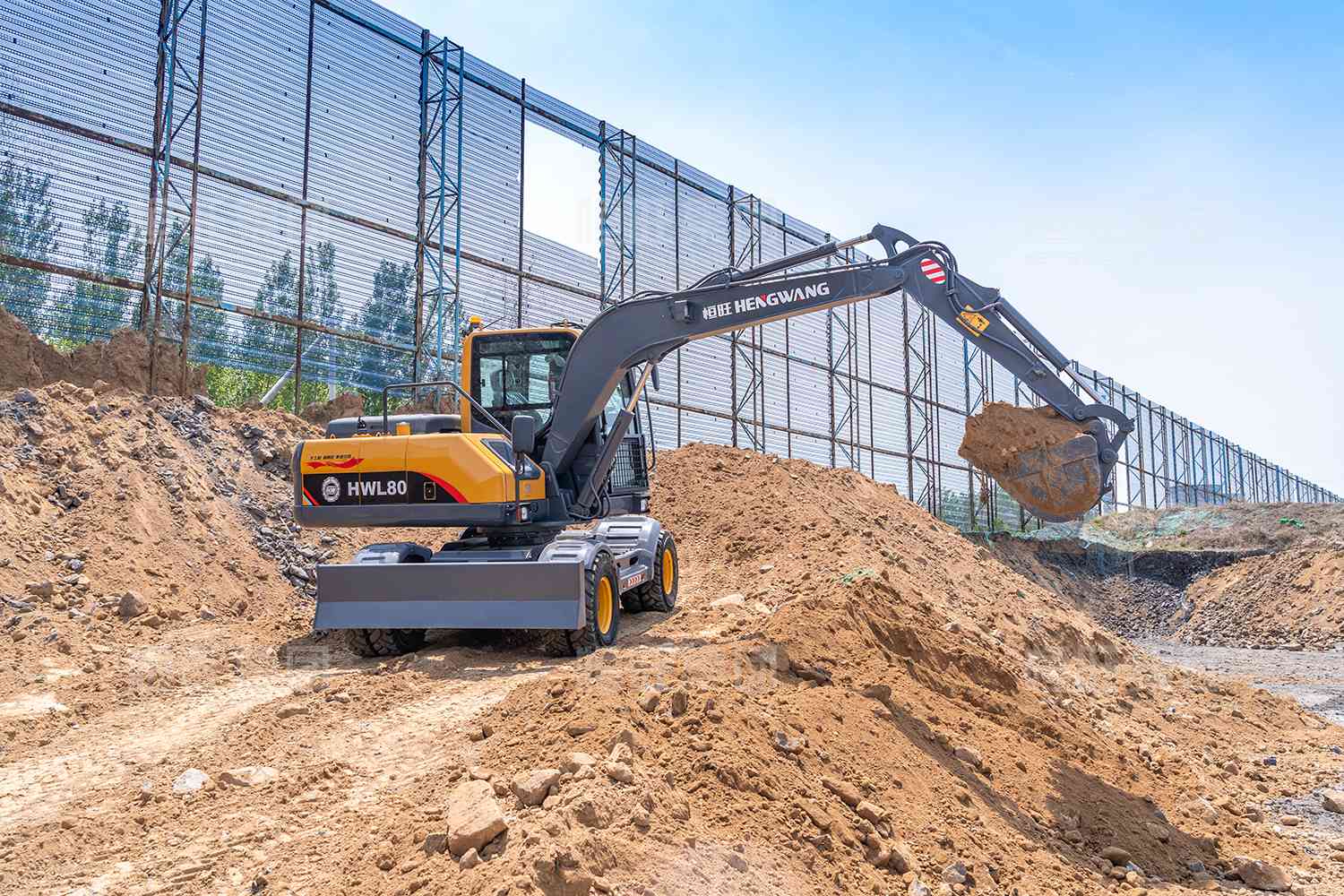
In the field of construction equipment, 8-ton wheel excavators ("wheel excavators" for short) have become the preferred machinery for complex scenarios due to their mobility and multi-functionality. From hard rock breaking to mountainous special operations, how do these machines exceed traditional limitations? A deep dive into their core adaptability for challenging working conditions:
1. Hard Rock Breaking: Stable Operation Under Vibration Conditions
For tasks like municipal road renovation and old district reconstruction, 8-ton wheel excavators quickly switch to breaker attachments, easily handling high-frequency vibration loads. Their anti-vibration reinforced body structure and precisely matched hydraulic system ensure overall stability during operation, minimizing component damage from resonance. When working on hard strata such as concrete pavements or rock foundations, wheel excavators leverage their flexible transportation to shuttle between multiple work sites efficiently, enabling seamless progress in breaking projects.
2. Mountainous Operations: Maneuverability in Rough Terrain
In mountainous environments with steep slopes and poor road conditions, the all-terrain tires and four-wheel drive system of 8-ton wheel excavators deliver exceptional passability. Wide tire treads provide ample grip, while the articulated frame adapts to uneven terrain, ensuring stable travel on muddy mountain roads or gravel slopes. During timber transportation after forestry felling, these machines can be equipped with winches and other auxiliary devices to drag distant logs to designated areas, solving the transportation challenge in hard-to-reach mountainous zones and becoming indispensable for forestry working conditions.
3. Attachment Adaptability: Quick Switching for Diverse Scenarios
The modular attachment design of wheel excavators allows seamless transformation for different tasks:
4. Narrow Spaces: Effortless Urban Operations
In restricted urban areas such as narrow roads and residential districts, the mobility of 8-ton wheel excavators shines. Their body width fits 2–3m narrow passages, with a minimum turning radius of approximately 5m, allowing free maneuvering in complex environments like alleys and lanes. Combined with sensitive controls, they accurately adjust digging depth and angle, efficiently completing tasks like pipeline trench excavation or obstacle removal in limited spaces while minimizing environmental impact.
5. Soft Terrain/Water Operations: Stability in Special Environments
For wetlands, riverbanks, and other prone-to-sinking conditions, the suspension system and tire design of wheel excavators offer reliable support. Adjustable tire pressure adapts to different ground hardness—low-pressure mode increases contact area to reduce sinking risk—while a high ground clearance protects the chassis from mud and water erosion. In water-related tasks like river dredging and farmland irrigation, their excellent sealing and anti-corrosion treatment ensure stable operation in shallow water, expanding construction adaptability.
Conclusion
8-ton wheel excavators break through the limitations of traditional excavators, standing out in complex scenarios like hard rock breaking, mountain operations, and urban construction with their mobility, attachment versatility, and terrain adaptability. Their integrated "travel+operation" capability not only boosts project efficiency but also reduces the cost of multi-machine collaboration. Gradually becoming an indispensable all-rounder in modern engineering, they provide reliable solutions for the most challenging working conditions.